
Multi-Tier Development Using RAD Server
Multi-tier architecture (also known as n-tier architecture) separates an application into distinct layers, typically including the presentation, business logic, and data access layers. This design enhances scalability, maintainability, and flexibility, making it ideal for complex applications.
N-tier architecture is ideal for remote and mobile applications as it removes the reliance on permanent connections on a local network. By using RESTful APIs in the business logic layer, remote clients can interact with server-side resources efficiently over HTTP. This setup allows for seamless integration across diverse platforms and devices, ensures secure and efficient communication, and enables independent scaling of different layers.
Who this page is for
- Teams that need to expose existing Delphi/C++Builder logic to mobile, web, or remote clients.
- Architects moving from monolithic desktop/data-coupled systems toward service boundaries.
- Teams that want to modernize incrementally without a full rewrite.
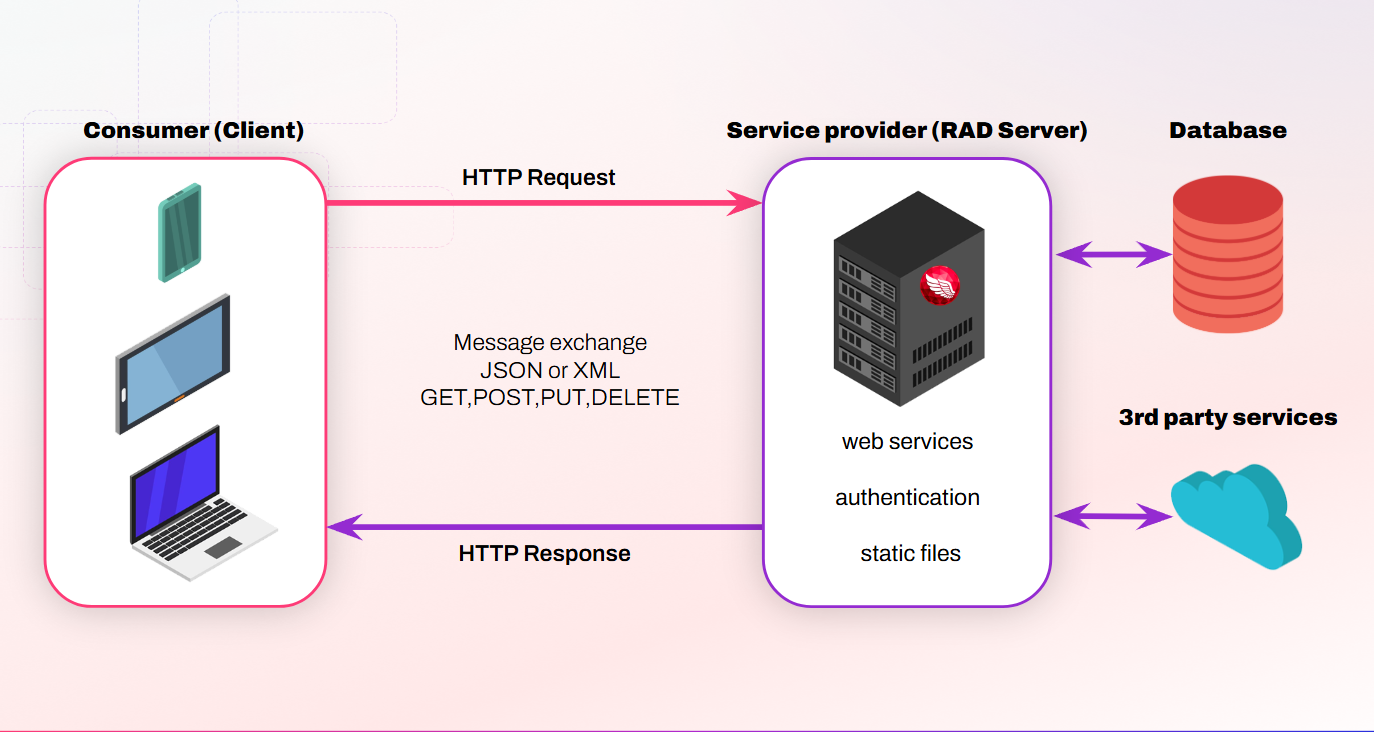
Getting More Value from Existing Delphi/C++Builder Code
As a RAD Studio developer, you’ve invested significant time and resources into business logic in Delphi or C++Builder. RAD Server helps you keep that investment by bridging your core logic to mobile, web, and remote clients. It transforms your code into versatile APIs, making your services available to any client or team, regardless of their development stack.
Seamless Integration with Existing Code
RAD Server lets you expose existing business logic as services without large rewrites. You preserve proven code, reduce duplicate implementation work, and deliver new capabilities faster.
Typical Tier Responsibilities
- Presentation layer: Web, desktop, or mobile clients that call APIs.
- Business logic layer: RAD Server modules that apply rules and orchestrate workflows.
- Data access layer: Data retrieval and persistence behind service boundaries.
Key Benefits of RAD Server for Existing Code:
- API Exposure: RAD Server allows you to expose your existing business logic as RESTful APIs. This enables remote clients, web applications, and mobile apps to interact with your logic from most programming languages without altering the core code.
- Extended Reach: With RESTful APIs, your existing codebase can now serve diverse clients, including web and mobile applications. This capability transforms your single-platform solution into a versatile, multi-platform offering, enhancing your application’s value and accessibility.
- Cross-Platform Deployment: RAD Server supports both Windows and Linux environments, providing flexibility in deployment. This means your code can run efficiently across different server platforms, accommodating varied IT infrastructures. It also supports mobile scenarios where traditional direct database connections are not practical.
- Efficient Modernization: RAD Server allows you to modernize your application incrementally. You can start by exposing critical business logic through RESTful APIs, and gradually integrate new features or migrate additional functionalities without overhauling your entire codebase.
Practical Thoughts on Expanding Your Application with a RESTful API
When adding a RESTful API to an application, begin with one use case. This is often mobile access, but it can also support remote work or partner integrations. Avoid moving everything at once; start with the capability that provides the clearest business value.
Once you have the use case, use the guide and examples below to shape endpoint design, authentication, and deployment decisions.
Practical first scope
- Pick one business capability that already has stable validation rules.
- Expose only the endpoints needed for that capability.
- Add authentication, logging, etc. from the first iteration.
- Expand service coverage after usage and error telemetry are stable.
RAD Server Guide
The official white paper covering architecture, setup, and deployment patterns for RAD Server-based APIs.
lp.embarcadero.com
Github repository with RAD Server examples
This repository compliments the guide and shows examples of each chapter for Delphi and C++Builder.
github.com
Build Flexible and Robust Apps with a Multi-Tier Architecture
Practical considerations for structuring your services and managing API boundaries when adopting a multi-tier architecture.
blogs.embarcadero.com
Common migration trap Do not move clients to REST while keeping the same tightly coupled database assumptions. Define clear service contracts and ownership boundaries first, or you will recreate monolith coupling at the API level.
https://www.youtube.com/watch?v=lCZeeZIHOTA
RAD Server webinar (Ian Barker) - A practical walkthrough showing how RAD Server modernizes apps and securely centralizes business logic for multi-tier architectures.
Practical Steps for Migration
- Expose Business Logic via RAD Server: Begin by identifying the core business logic in your existing Delphi/C++Builder applications that you want to expose. Use RAD Server to create RESTful APIs that provide access to these functionalities, effectively turning your legacy logic into a service-oriented architecture.
- Integrate RESTful Services: Implement RAD Server’s RESTful endpoints to allow client applications, whether web, mobile, or desktop, to interact with your existing business logic. This integration makes your services accessible across various platforms and devices, enhancing their reach.
- Deploy and Test: Deploy RAD Server on your preferred server environment (Windows or Linux) and rigorously test the new APIs to ensure they integrate smoothly with your existing code and meet performance expectations.
- Expand Incrementally: Start with one service boundary, validate usage and reliability, then broaden API coverage in stages.
Other Options for n-tier development with RAD Studio
DataSnap and MIDAS have long been powerful tools in the RAD Studio ecosystem for building multi-tier applications, enabling developers to create distributed systems with data access and remote procedure calls. While they share similarities with RAD Server, such as facilitating the separation of business logic and data access layers, RAD Server offers a more modern approach. Unlike DataSnap and MIDAS, RAD Server is designed specifically for RESTful API development, providing built-in support for RESTful services, user management, API analytics, and cross-platform deployment. It’s a more versatile and scalable solution, particularly suited for extending existing Delphi and C++Builder applications into the web, mobile, and cloud environments.
There are also several community-driven and commercial projects around RESTful development. Some are Delphi-specific and worth evaluating as alternatives to RAD Server, including Delphi MVC Framework, Horse, TMS XData, mORMot, and Dext Framework.
Final Thoughts
By adopting a RESTful architecture, you can continue to extract value from the business logic you’ve built over the years. Exposing existing Delphi and C++Builder code through APIs preserves your investment while modernizing delivery for today’s clients. RAD Server gives you a practical way to extend capability without starting from scratch.